If your heart could talk, it wouldn’t ask for punishment workouts. It would ask for steady work it can recover from, like a brisk walk that leaves you clear-headed, or beginner strength training that makes stairs feel easier.
This 12-week plan is built for real beginners. You’ll learn the basics, build confidence, and train in a way that supports blood pressure, blood sugar, and daily energy. Pair it with a heart healthy diet, and you’ve got a simple system you can keep for life.
Why strength training helps your heart (without turning workouts into chaos)
When you get stronger, everyday tasks cost less effort. Carrying groceries, standing up from a chair, and walking uphill all demand less from your heart. That’s one reason strength training can feel like a “quiet cardio.”
Recent research summaries (including a 2024 study reported in the Journal of the American College of Cardiology) link consistent resistance training with better blood vessel function over time. In plain words, your arteries can respond better, so your heart doesn’t have to push as hard.
Strength work also supports the stuff that shapes heart risk in the background: insulin sensitivity, body composition, and stress. It’s especially helpful when you combine it with regular walking or cycling. The American Heart Association and major medical groups consistently recommend a mix of aerobic activity and strength work for overall heart protection. Johns Hopkins explains this “mix and match” approach well in its overview of exercise types that boost heart health.
If you want more detail on heart-safe lifting, including pacing and breathing, see these strength training routines for heart health.
If you can’t breathe smoothly, the set is too hard for today. Lower the weight, slow down, or rest longer.
The rules that make this plan heart-friendly (schedule, effort, and safety)
This plan uses three guardrails: moderate effort, clean form, and enough rest. You’re not chasing max lifts. You’re building repeatable strength that supports cardiovascular fitness.
Effort target: Most sets should feel like a 6 to 8 out of 10. The last few reps feel challenging, but you could still do one more with good form. Keep the “talk test” in mind. You should be able to say a short sentence between sets.
Breathing rule: Exhale on the hard part (standing up, pressing up, pulling back). Avoid breath-holding “grind reps,” which can spike blood pressure.
Warm-up (6 minutes): easy walk or bike, then 8 squats to a chair, 8 hip hinges, and 10 arm circles each way. Finish with one light practice set of your first exercise.
Safety first: If you have chest pain, unexplained dizziness, uncontrolled high blood pressure, or a recent heart event, get medical clearance before starting.
Here’s the simple weekly structure you’ll follow for 12 weeks:
| Weeks | Strength days | Strength focus | Easy cardio (weekly) |
|---|---|---|---|
| 1 to 4 | 2 days | learn form, steady pace | 90 to 150 minutes |
| 5 to 8 | 3 days | add volume, small progress | 120 to 180 minutes |
| 9 to 12 | 3 days | a bit heavier, still controlled | 150 to 210 minutes |
The cardio can be brisk walking, cycling, swimming, or anything joint-friendly. If you want beginner ideas, Blue Cross NC shares a short list of heart-healthy exercises for beginners.
The 12-week beginner strength training plan (two workouts you rotate)
You’ll rotate two full-body workouts (A and B). On strength days, do one workout, then alternate next time.
Suggested week layout
- Weeks 1 to 4: Monday (A), Thursday (B)
- Weeks 5 to 12: Monday (A), Wednesday (B), Saturday (A), next week flips
Workout A (lower body plus push and pull)
- Goblet squat to a box or chair: 2 to 4 sets of 8 to 10
- Supported one-arm dumbbell row: 2 to 4 sets of 10 per side
- Incline push-up (bench, counter, or wall): 2 to 4 sets of 8 to 12
- Glute bridge: 2 to 3 sets of 10 to 12
- Farmer carry (light dumbbells): 3 short walks of 20 to 40 seconds
Rest 60 to 120 seconds. If your breathing stays high, rest longer.
Workout B (hinge focus plus posture and core)
- Dumbbell Romanian deadlift (light): 2 to 4 sets of 8 to 10
- Step-ups (low step): 2 to 3 sets of 8 per leg
- Dumbbell floor press (or machine press): 2 to 4 sets of 8 to 12
- Band pull-aparts (or lat pulldown): 2 to 3 sets of 12
- Dead bug (slow): 2 sets of 6 per side
Keep reps smooth. Think “steady hills,” not a sprint.
How to progress each phase (without guessing)
- Weeks 1 to 4: Start with 2 sets for most moves. Add reps before weight.
- Weeks 5 to 8: Move to 3 sets on the first 3 exercises. Add a small weight bump when you can keep form.
- Weeks 9 to 12: Keep 3 to 4 sets on key moves. Use slightly heavier weights, but stop 1 to 2 reps early.
Progress isn’t proving you’re tough. Progress is showing up, then adding one small coin to the jar.
If you want a short add-on day, Fit and Well has an example of a 15-minute beginner workout for heart health. Keep it easy if you lift the same day.
Food that supports heart health and strength (simple, not strict)
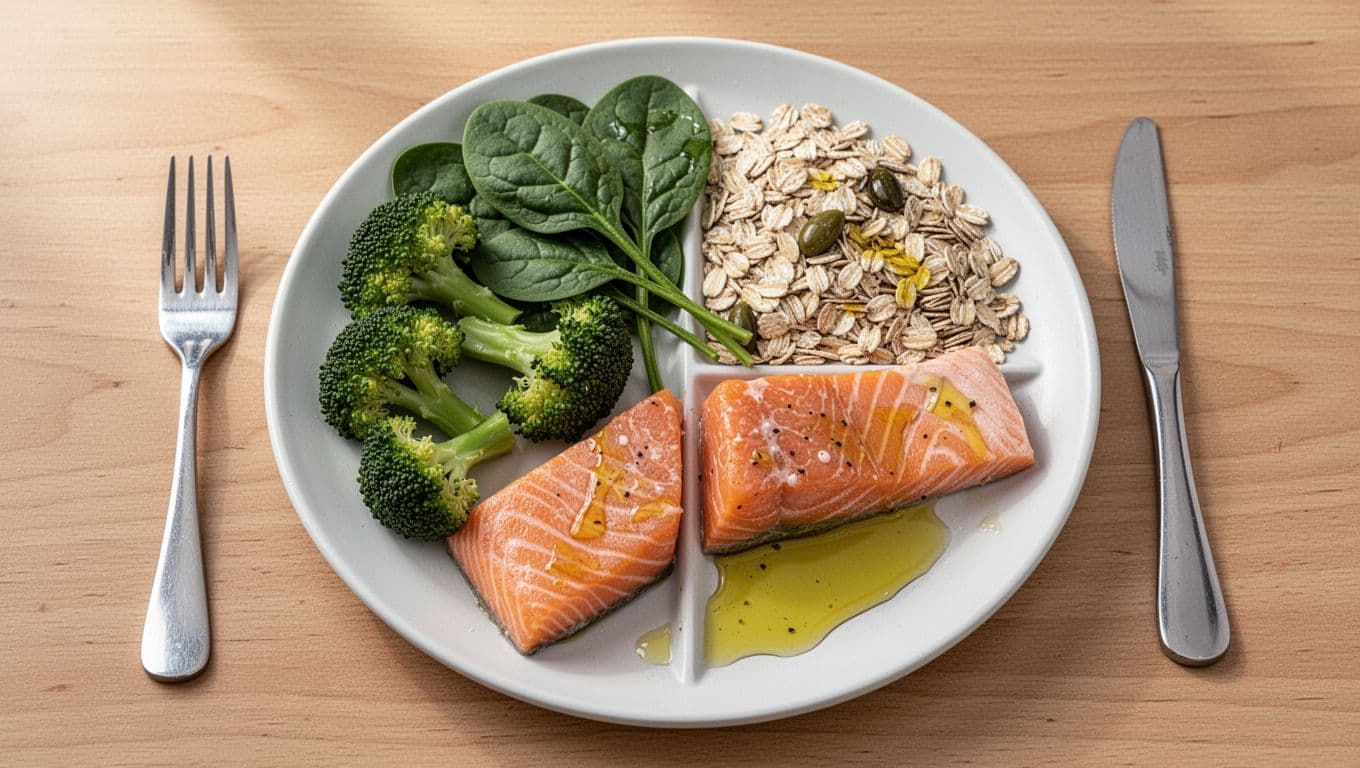
Training is the spark, but food is the slow-burning log. A healthy food diet for heart health doesn’t need perfection. It needs repeatable meals that keep fiber high, sodium reasonable, and protein steady.
Use this simple plate most days: half vegetables, a quarter protein, a quarter high-fiber carbs, plus a little unsaturated fat. That’s healthy nutrition you can scale up or down, depending on hunger.
Two practical anchors:
- Before lifting (30 to 90 minutes): yogurt plus fruit, or toast plus peanut butter.
- After lifting (within a few hours): protein plus carbs, like salmon and oats, or beans and rice.
This is also nutrition to prevent illness, because the same pattern supports cholesterol, blood pressure, and blood sugar. For a step-by-step grocery approach, use this heart-healthy foods guide.
Some people also have inherited risk factors that diet can’t fully “fix.” If early heart disease runs in your family, ask your clinician about screening. This explainer on the Lipoprotein(a) test breaks it down in plain language.
If you enjoy food photos while meal planning, you can browse free inspiration in this Unsplash organic label collection.
Conclusion: build strength, then let it carry you
A heart-supportive routine doesn’t have to be loud. With beginner strength training two to three days a week, plus walking and a heart healthy diet, you’re practicing the kind of healthy living diet and exercise that ages well. Think of it as sports and exercise for long life, done at a pace you can repeat. Start week 1, keep it steady, and in 12 weeks you’ll feel the difference in your breath, your posture, and your day.



0 Comments