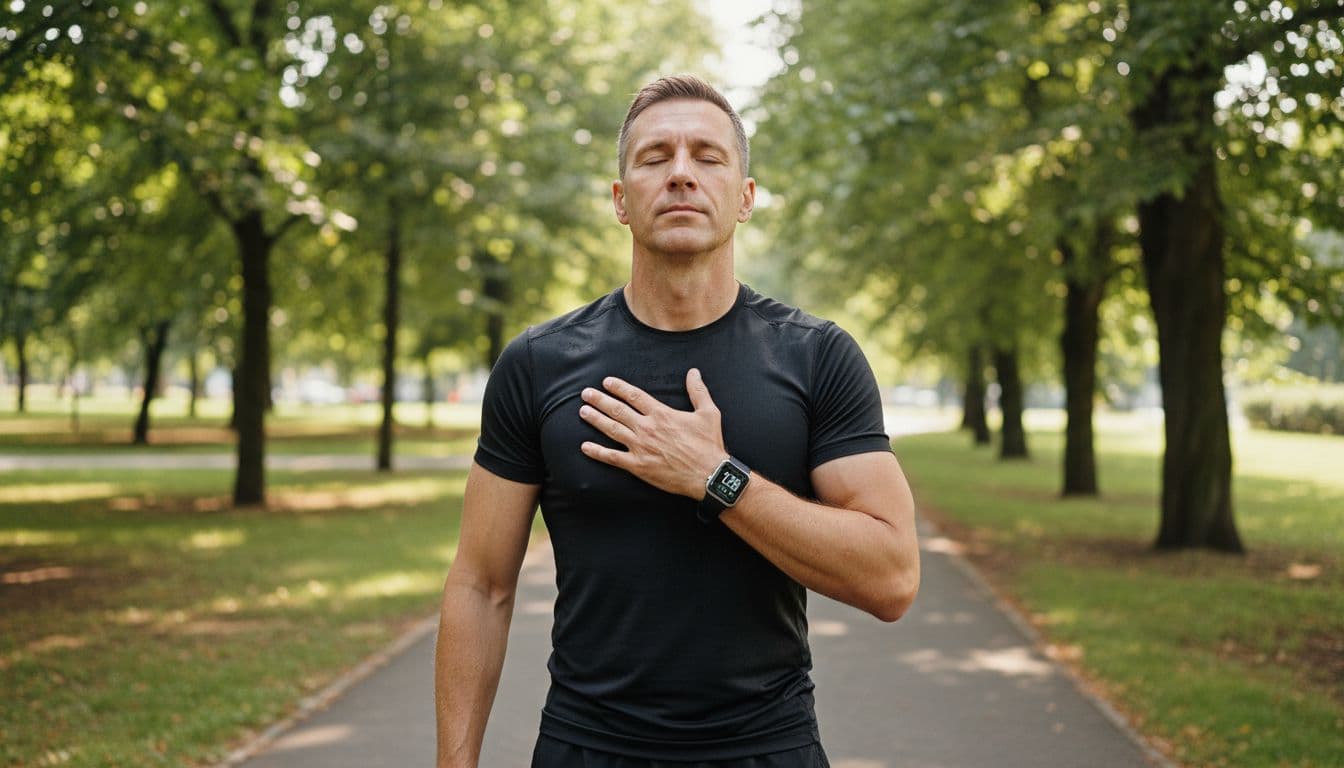
How fast does your pulse settle after a hard walk, jog, or bike ride? That simple drop, called heart rate recovery, can tell you a lot in one minute.
In general, a faster drop points to better fitness and a healthier recovery response. A slower drop doesn’t always mean something is wrong, but it can be a clue worth watching, especially if the pattern repeats.
Why heart rate recovery matters
Think of your heart like a car engine after a steep hill. A well-tuned engine calms down fast when the climb ends. Your heart should do something similar after exercise.
During hard effort, your body leans on its “go” system. Once you stop, the “rest and recover” side should step in and bring your pulse down. Heart rate recovery measures how quickly that handoff happens.
That matters because heart rate recovery reflects both fitness and nervous system balance. A strong number often shows that your heart and blood vessels handle stress well. Recent research still supports HRR as a useful marker of long-term heart health and overall risk.
A rough rule helps: a 1-minute drop of 15 to 20 beats or more is usually reassuring, while a drop under 12 to 15 beats can be a warning sign, depending on the setting. Still, this isn’t a stand-alone diagnosis. Age, medicines, heat, sleep, and training fatigue all shape the result.
If you use a smartwatch, Cardiogram’s overview of HRR gives a helpful look at how wearables track it.
How to do a heart rate recovery test at home
The best test is simple and repeatable. Keep the workout, device, and recovery method as similar as possible each time.
- Warm up for 5 to 10 minutes.
- Exercise hard enough to raise your heart rate well above easy pace.
- Stop and note your peak heart rate right away.
- Check your heart rate again exactly 1 minute later.
- Subtract that second number from the peak.
If you stop at 165 beats per minute and one minute later you’re at 145, your heart rate recovery is 20.
Keep the conditions steady. For example, always stop fully, or always walk slowly during recovery, but don’t switch back and forth. Otherwise, the number gets muddy.
Beta-blockers and other heart medicines can change the result. So can dehydration, caffeine, heavy training, poor sleep, and hot weather. As a result, one odd reading means less than a trend across several tests.
Stop exercising and get medical care if you feel chest pain, faint, or become unusually short of breath.
What your heart rate recovery number means
A chart can’t tell your whole story, but it gives a strong starting point.
| 1-minute HRR drop | General meaning | What to do next |
|---|---|---|
| 20+ bpm | Strong recovery | Keep tracking the trend |
| 15 to 19 bpm | Fair to good | Usually a healthy sign |
| 12 to 14 bpm | Borderline | Retest under the same conditions |
| Under 12 bpm | Low | Discuss it if it repeats, especially with symptoms |
The takeaway is simple: faster is usually better, but consistency matters more than one isolated test.

Photo by Ketut Subiyanto
One poor result after a bad night’s sleep shouldn’t spark panic. On the other hand, repeated low scores, a clear drop in exercise tolerance, or symptoms during workouts deserve attention. For another athlete-friendly view of common ranges, Marathon Handbook’s heart rate recovery guide is a useful reference.
How to improve heart rate recovery with food, training, and sleep
The fastest way to improve heart rate recovery is usually boring, which is good news. Build your aerobic base with walking, cycling, jogging, swimming, or rowing. Then add strength work, because stronger muscles make the same task cost less effort. These heart-safe lifting routines can support that goal.
Sleep matters too. When you’re run down, your pulse often stays high longer after exercise. Stress can do the same. So can stacking hard workouts without enough easy days.
Food also plays a real role. A heart healthy diet built on beans, oats, fruit, greens, yogurt, nuts, olive oil, and fish helps support blood vessels and recovery. No supplement replaces healthy food eaten often. If your healthy food diet still feels blurry, this heart healthy foods guide makes it easier to build repeatable meals.

This is healthy nutrition in plain clothes. It’s also nutrition to prevent illness, because daily meals shape blood pressure, inflammation, and energy. The larger goal is a healthy living diet and exercise routine you can keep through busy weeks. In that sense, sports and exercise for long life look less like punishment and more like rhythm.
A simple number worth tracking
Heart rate recovery is not fate, but it is useful feedback. Test it the same way each time, watch the trend, and support it with steady training, sleep, and a realistic eating pattern. If the number stays low or symptoms show up, bring it to a clinician. One minute after exercise can reveal more than most people think.

0 Comments